
Effective compliance
Compliance with CTC means that a contacting state:
- takes all action to ensure that CTC has the force of national law with priority over any conflicting law (effective implementation)
- fully and accurately applies the operative terms of CTC to actions and disputes within its scope, whether administratively or judicially
In other words, a contracting state complies with CTC when the treaty legally applies, and is fully and accurately applied, to matters within its scope.
AWG work on compliance
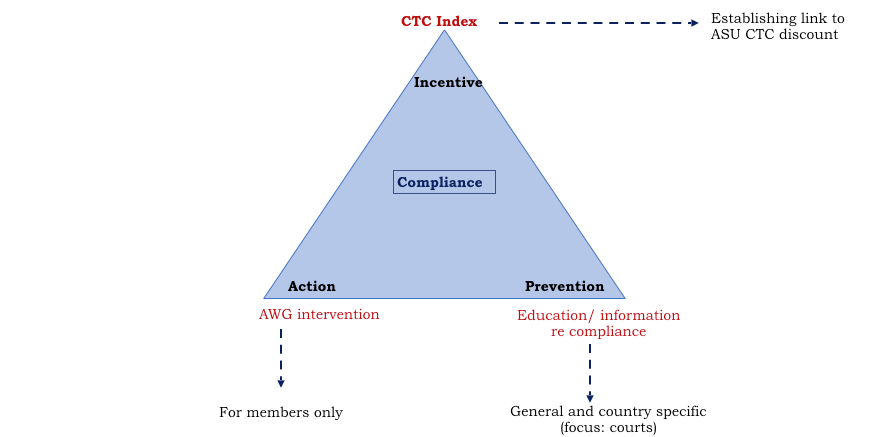
AWG works on state compliance with CTC in three ways:
- promoting incentives to comply (though index scoring and eligibility for export credit discounts)
- preventing non-compliance (through education and information)
- acting to address non-compliance (for AWG members only)
For incentives, see corresponding section.
For prevention, see corresponding section.
For action, AWG consults with governments and intervenes in administrative and legal proceedings on behalf of its members when so requested by its members.
AWG also establishes coordinated compliance action groups to seek compliance in large scale insolvency or insolvency type events to which CTC applies and which involve our members.
The following chart depicts our approach to compliance:
Incentive: Cape Town Convention compliance index
AWG released the inaugural edition of the CTC compliance index on 29 February 2020.
AWG releases its semi-annual updates in April and October, see Cape Town Compliance Index for most up to date scores.
The Cape Town Convention Compliance Index (CTC compliance index) monitors and assesses compliance by contracting states with their undertakings under CTC.
The CTC compliance index is hosted on a separate platform, which can be found here. Visit the CTC compliance index platform for all information on the CTC compliance index.
Several of AWG’s historical projects reporting on implementation have merged into this project, including its past work on summaries of national implementation for contracting states. A parallel and equally significant goal of the CTC compliance index is to incentivize future compliance by providing accurate, timely information to stakeholders, including the OECD, and communicating concrete proposals for improving compliance in the applicable contracting state.
AWG works with over 300 law firms worldwide, including our established network of national contact groups, to obtain all compliance-related data and experience. Such data and experience are then analyzed by the AWG secretariat. AWG’s legal advisory panel reviews proposed scoring, and a final determination on scoring based on legal facts is made by the AWG secretariat without regard to political or economic considerations.
CTC compliance index watchlist notices
CTC compliance watchlist notices (‘watchlist notices) are issued to indicate that AWG has become aware of material developments in a contracting state that may affect the score but has not yet completed its assessment of the impact of such material developments. Watchlist notices provide an outlook on scoring with reference to the contracting state’s existing score rather than CTC compliance per se. For example, where the affected variable is low in a contracting state, a further non-compliant development will be assigned a ‘confirmatory’ outlook. Once a contracting state is placed on the CTC Compliance Watchlist, AWG will closely monitor ongoing developments and issue reports on a regular basis with fact-based, events-driven updates.
Note on the interpretation of watchlist notices issued on the Index can be found here.
Visit the CTC compliance index website for more information.
Coordinated compliance action groups
AWG creates coordinated compliance action groups (CCAG) when faced with an actual or anticipated airline insolvency or other non-performance in a contracting state.
A CCAG supports AWG submissions and interventions, serves as an information center, assists in contacting local government officials, and helps develop timely updates on the CTC compliance index.
Interventions
AWG may, depending on facts and circumstances, seek to intervene, as a friend of the court in legal proceedings or with insolvency administrators or administrative authorities seeking compliance with CTC. We only do so for our members. We limit our interventions to seeking compliance with the requirements of the treaty.
AWG has submitted compliance-related papers in Australia, Brazil, Colombia, Ireland, India, Luxembourg, Malaysia, Mexico, Norway, Nigeria, Russia, Singapore, South Africa, Sweden, Türkiye, United Kingdom, and the United States.
Working relations
AWG has long-standing working relations and formal status with a wide range of governments, intergovernmental bodies, industry groups, and academic institutions, and policy groups.
Prevention of non-compliance: educational materials and educational outreach
AWG actively engages and interacts with contracting states, seeking compliance, through educational resources and informational events. AWG provides state of the art educational materials on CTC topics and holds regional events worldwide.
Independent expert opinion concerning the application of CTC under Chapter 11 of the US Bankruptcy code involving a non-US debtor
An independent expert opinion has been issued on the application of CTC under Chapter 11 of the US Bankruptcy code involving a non-US debtor.
It concludes that the courts of the United States, including courts having jurisdiction over a non-US Airline Chapter 11 bankruptcy case (or over any other case under the Bankruptcy Code), are obligated to apply Protocol Article XI Alternative A in conformity with the declaration made by the State which is that airline’s primary insolvency jurisdiction (where its center of main interests are situated and whether or not insolvency proceedings are under way in that State) without further legislation or implementation by the United States.
The independent expert opinion may only be used in full, as its must be read as a whole.
Assessment of CTC and schemes of arrangements in the insolvency context
An expert opinion has been issued on CTC and restructuring plans and schemes of arrangements in the insolvency context.
It concludes that schemes of arrangement proceedings in the insolvency context are ‘insolvency proceedings’ for purposes of the Cape Town Convention. Thus, modification of a CTC creditor’s rights without its consent is not permitted in such proceedings – where the debtor’s main place of business is in a CTC state which declared or incorporated Alternative A (remedies on insolvency). The foregoing is without prejudice to actions taken in connection with a CTC compliant scheme, which includes providing each CTC creditor with a termination option.
The expert opinion may only be used in full, as its must be read as a whole.
Resource materials on insolvency
AWG has released a suite of resource materials on insolvency. These materials include the Law and Practice of Cross-Border Insolvency and its Intersection with CTC, Summary and analysis of provisions in the CTC on, or which impact, insolvency, and Insolvency-related opinions and materials.
In addition, AWG has also published an Analytic CTC Insolvency Database (ACID). A database of insolvency cases in the avnation industry. ACID is available for AWG members and AWG’s legal advisory panel.
Compliance materials
Self-instructional materials
AWG with the support of the panel, has prepared comprehensive self-instructional materials for individuals needing information about the Cape Town Convention (CTC).
These “self-instructional materials” have been assembled in the context of the Cape Town Convention academic project (CTCAP), and seek to assist scholars, students, practicing lawyers, judges and other government officials, as well as the industry at large, by providing information on and education about the CTC.
These self-instructional materials have been translated by the panel into:
Judicial guide
AWG with the support of the legal advisory developed the judicial guide handbook setting out fundamental CTC items arising in the litigation context. The judicial guide is also available in Arabic, French, Spanish, and Mandarin.
The practitioner’s guide
AWG with the support of the Legal Advisory Panel published the 2023 edition of the Practitioners’ Guide. It is designed to provide practical assistance to practitioners in working with the Cape Town Convention (CTC). The practitioners’ guide is also available in Arabic, French, Spanish, and Mandarin.
Civil aviation authority guide
The Civil aviation authority guide guide sets out fundamental CTC items arising in the context of interaction, with actions and decisions by, civil aviation authorities. The CAA guide is also available in Arabic, French, Spanish, and Mandarin.
Principles-based guide to the Official Commentary (revised 5th ed)
The principles-based guide was developed as a guide and reference document for using and understanding the Official Commentary to the CTC and the principles on which it is based.
Country-specific
After the passage of the Protection of Interests in Aircraft Objects Act, 2025 (the CTC Act), critically important legislation designed to give full force and effect to, and ensures the primacy over inconsistent law of, CTC, AWG released a white paper.
The white paper seeks to maximize the consistent and correct interpretation of the CTC Act (white paper No. 1). Its content has been agreed by AWG’s Indian Contact Group.
Technical note: We use the phrase ‘cape town convention’ or ‘CTC’ to mean the convention on international interests in mobile equipment and its aircraft protocol. Where needed, the ‘convention’ and ‘protocol’ are referred to individually.